
Monday, June 2, 2025
The Pale Baron by Kopergiertery

Tuesday, April 22, 2025
Monday, April 21, 2025
Toby Thompson's The Little Prince, produced by The Egg Theatre, Bath


Tuesday, April 1, 2025
Involving children & young people in the arts - presentation for #BrightGenerations Assitej Artistic Gathering 2025


Monday, March 31, 2025


Sunday, March 30, 2025
Top 3 Shows of Assitej 2025 - in no particular order...(and I didn't see them all)


Friche la Belle de Mai - What an exciting venue for #BrightGenerations Assitej Artistic Gathering 2025


Tuesday, June 18, 2024
Assitej Awards for people from UK - Lifetime Achievement Award for Vicky Ireland & Emerging Scholars Award for Dr. Kitty Morley


Saturday, June 8, 2024

Entendemos La Historie, Esta es La Revolución - Understand History, This is the Revolution
A word about Cuba the country... So much complexity around the economy, the government currency rates, the pesos for dollars on the streets... power cuts... some notes here to help find a way through.
Why does the US have Guantanamo? It was 100 yr lease for 1902 when the US helped to fight the Spanish.
My airbnb host told his story of the revolution. 1953 and Castro's fight against Batista and subsequent capture and trial where he defended himself...'History will observe me.' His exile.
His return in 1956 in a boat with just 82 men. And his fight from the East to the West of the island between 1956 to 1959.

Until December 1958 when Batista flees to the Dominican Republic with 300 million dollars.
The Bay of Pigs 16th-19th April 1961. And cuban missile crisis in 1963, when Castro was unhappy that Kruschev did a deal with Kennedy.


To Hell with Paradise - Batida Theatre, Denmark

The show takes place outside, under a metal roof, in case of rain. Bated are experienced at playing in Cuba & they have brought their own generator in case of power cuts.

The Festival goers arrive on a bus & are greeted with much excitement by the group of local children. However once the actors descend from their bus, the excitement doubles and the show begins. The serpent enters, and there is Adam and Juliet and an apple.

Each scene has captions in Spanish and is separated by a musical number from a Rock Band. The mix of Shakespeare and Genesis temptation story unfolds. There is a moment of death & tragedy when Juliet's pregnancy is discovered.
However the magic of theatre steps in via the Serpent, who explains that Juliet's pregnant stomach is 'only a balloon'. And the star-crossed lovers are given a ticket to Freedom
Friday, June 7, 2024
Kopergierty - a theatre for young people in Belgium - Culture Is Not Only Inherited From The Past, But Also Borrowed From Next Generations!


The overall emphasis is on working with contemporary artists, and to attend to the new developments of a rapidly changing society - and to the need for children to access new technology.
This is alongside the need for well-being, education, playful chaos and a sense of belonging.
The Value of Theatre for Young People - Can we discuss the value of the Art? Or are we stuck with secondary outcomes of Education, Health and Social?

What was most surprising was to attend a seminar on the value of theatre for young people and to find that none of the value measurements included the aesthetic value. This is ASSITEJ's 'Building Collective Resilience' strand of work, a part of which aims to bring together published academic papers as well as evaluation reports (so called 'grey papers' written by practitioners and theatre companies but not peer reviewed) to build a bank of evidence for the value of theatre for young people. Evidence needs to include an element of self-reporting by children. Whilst it is not surprising that this includes aggregating evidence in terms of sectors such as education, health and social, what is surprising is that there is no acknowledgement of the aesthetic value.

Whilst this is notoriously hard to measure, there has been the important findings from the New Victory 2021
and there are approaches that were discussed at Assitej Capetown 2017 (see below)
Are we measuring what matters? Or is it even possible to measure? Probably not, art is inherently subjective so it is not possible to find a metric to measure definitively. And in live theatre different performances will vary with different audiences. To paraphrase Francois Matarasso, we do not look to find if the show is excellent in some abstract sense but if it is excellent on this night, with this audience, in this place. And everyone will have their opinion, judgment and discernment. For Mr. Hisashi Shimoyama, from the Rica Rica Festival in Japan, a good piece of theatre for young people was one that encouraged children to continue to live. How do we measure this? Are their eyes engaged in the action? Is there a collective gasp at a reveal in the plot? Are they laughing at moments you expect, or at other moments? Are they talking about the show afterwards?
Mary Rose Lloyd from the New Victory Theatre suggested a definitive system of measurement is elusive as a Unicorn.
However, it is useful to have some questions and statements to prompt those conversations, whether with peers, with children and young people, teachers or other stakeholders. So for the record, here are the ways, as discussed at Assitej2017.
The Danish Seven
1. Artistic objectives
Does the company have a genuine commitment to its work?
Why this production? Why are they making theatre at all?
Is it evident that this particular company see the need of playing this particular play in this particular way at this particular time?
2. The Text (Alternatively in the case of productions with little or no text:the dramatic development)
Is there a dramaturgical development?
3. The Solutions to the staging
Meaning all the decisions taken in relation to the text eg. Design, music, direction.
What is the impression as a whole?
4. The Actor’s work
The characters – are they credible? Do they develop? Are they multi-faceted?
What is the interplay with the spectators?
5. Relations to the audience
Are the children (in the audience) taken seriously?
Does the production captivate its audience?
Is it clear that this particular company is concerned about addressing this particular audience on this special day?
Are they prepared to respond to the audience?
6. Relations between the intentions and the abilities of the company
Do the ambitions match the skills of the company?
7. Ethics
The ultimate and overall idea of the production.
What is the encounter?
Arts Council England Seven (for children and young people – all arts)
1. Striving for excellence and innovation
2. Being authentic
3. Being exciting, inspiring and engaging
4. Ensuring a positive and inclusive experience
5. Actively involving children and young people
6. Enabling personal progression
7. Developing belonging and ownership
The Australian Five (all arts)
1. Captivating
2. Emotional resonance
3. Intellectual stimulation
4. Aesthetic enrichment
5. Social bridging and bonding
The Arts Council England Nine (all arts)
Statements from which artists can invite audiences to tell them what they value about the work. Each statement is scored on a simple metric scale.
1. Concept: it was an interesting idea
2. Presentation: it was well produced and presented
3. Distinctiveness: it was different from things I’ve experienced before
4. Challenge: it was thought-provoking
5. Captivation: it was absorbing and held my attention
6. Enthusiasm: I would come to something like this again
7. Local impact: it is important that it's happening here
8. Relevance: it has something to say about the world in which we live
9. Rigour: it was well thought through and put together
ASSITEJ CUBA - We need new voices for a new world; let us make them heard!
The 21st ASSITEJ World Congress & Performing Arts Festival for Children & Young People
Entitled Voices of a New World, the event took place in Havana, Cuba from 24th May to 1st June 2024
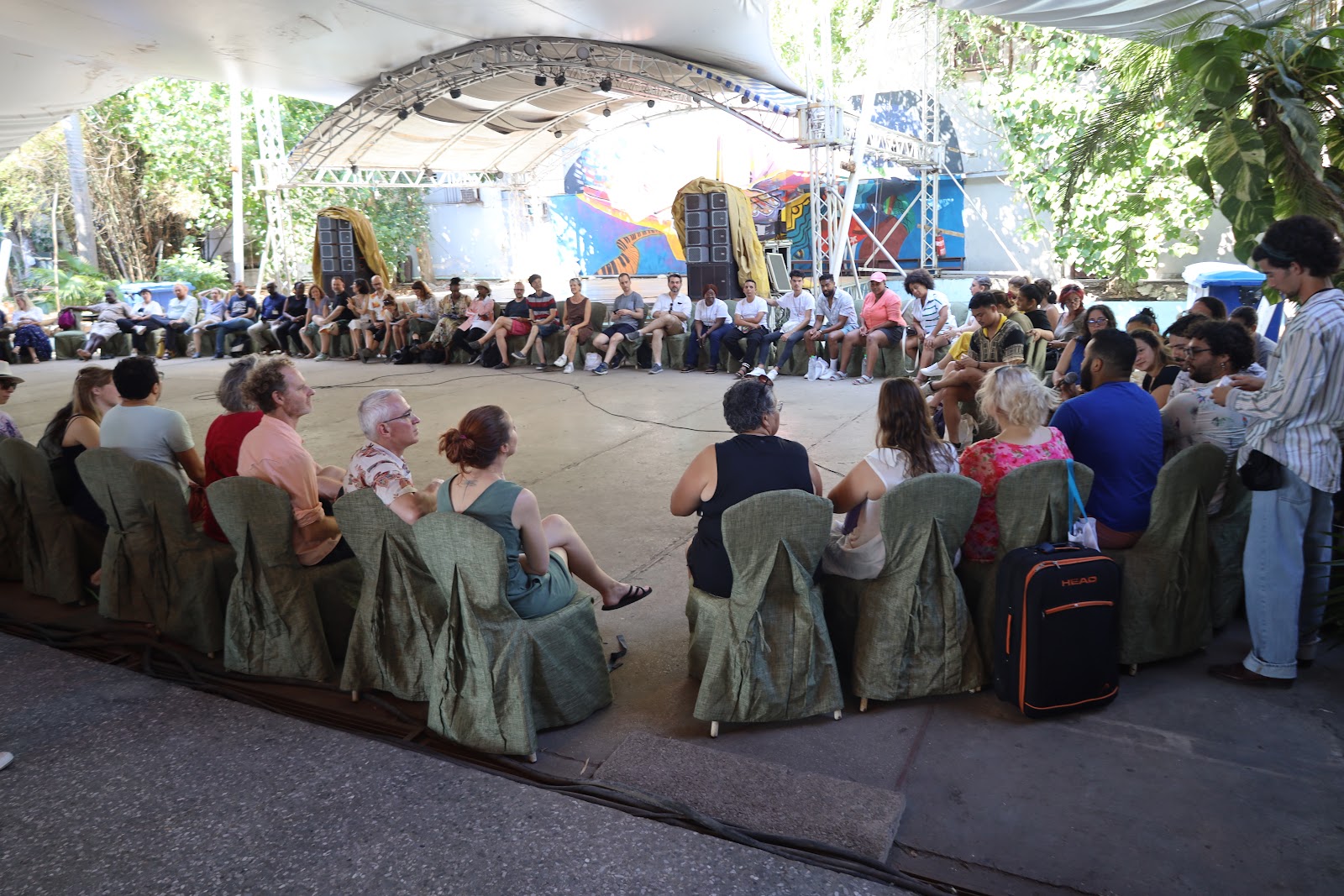
1000+ Artists from 70+ Countries • 65 Workshops, Talks & Discussions • 25 Performances from 5 Continents

A key challenge was to make space for the next generation voices to be heard
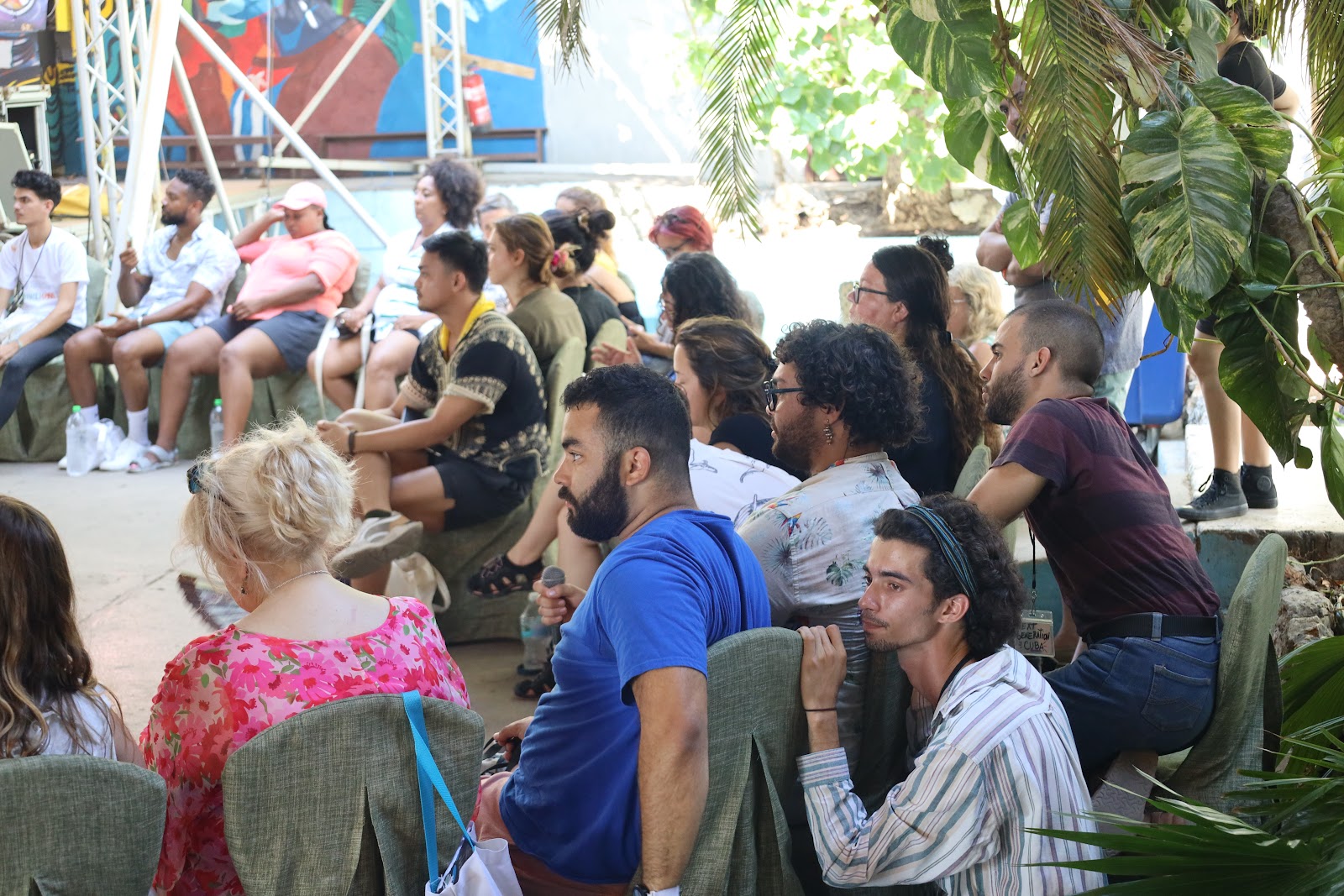
Thursday, June 6, 2024
Co-creation internationally - Children are the same all over the world - As crianças são as mesmas em todo o mundo
The idea that commonalities for children predominate more than differences, was clear from discussion with Teresa Rotemberg. Her talk identified the need for friends, the fear of being alone, the sadness, the desire to be perceived, the pleasure of being in a family... common to children across the world.

These are some of the co-creation methods from the collaboration with the Wisbech and Fenland Museum.
I give a specific example of the artistic process.
I give some detail of how we make the project.
- We work in a region called Fenland, where there is very little cultural provision, but there is a museum
- We work in partnership with the museum
- Take objects from a local museum to schools
Patrimonio/Museos
Doy un ejemplo concreto del proceso artístico.
Doy algunos detalles de cómo realizamos el proyecto.
- Trabajamos en una región llamada Fenland, donde hay muy poca oferta cultural, pero hay un museo
- Trabajamos en colaboración con el museo
- Llevamos objetos del museo local a las escuelas
- Make a map of the local area, a co-created map
- Children write stories inspired by these objects.
- And for this process we create a space of quiet when the children can write uninterrupted for about 20 minutes.
- Hacer un mapa de la zona, un mapa creado conjuntamente.
- Los niños escriben historias inspiradas en estos objetos.
- Y para este proceso creamos un espacio de tranquilidad en el que los niños pueden escribir sin interrupciones durante unos 20 minutos.
- We say that every story will be read by us the artists
- We give special paper and pens and a freedom to write whatever they want.
- Decimos que cada historia será leída por nosotros, los artistas.
- Les damos papel y bolígrafos especiales y libertad para escribir lo que quieran.
- We sometimes give a frame – and use a limitation as a stimulation.
- A story which involves the object, the location…
- A story where something happens, where characters change/transform
- A story that may have action, horror, comedy, romance, adventure…
- A mix of fact and fiction – and there are different ways into a story – for example - I ask the children to include 2 truths and a lie – some things that happened but something that you have imagined.
- A veces damos un marco y utilizamos una limitación como estímulo.
- Una historia en la que interviene el objeto, el lugar...
- Una historia en la que ocurre algo, en la que los personajes cambian/se transforman
- Una historia que puede tener acción, terror, comedia, romance, aventura...
- Una mezcla de realidad y ficción - y hay diferentes maneras de escribir una historia - por ejemplo - les pido a los niños que incluyan 2 verdades y una mentira - algunas cosas que sucedieron pero algo que han imaginado.
- If they can’t write, we can support and ask them to tell us a story and we will write
- If they can’t think of a story I might say, I am thinking of a story can you guess what it is.
- Always a child will find a story
- Si no saben escribir, podemos ayudarles y pedirles que nos cuenten una historia y nosotros escribiremos.
- Si no pueden pensar en una historia, puedo decirles: "Estoy pensando en una historia, ¿adivinas cuál es?
- El niño siempre encontrará una historia
- It is important that the child has the authentic creative process, to experience how to make something from nothing – and this is what is special – seeing the children enjoy this - for 20 mins you can feel in the room the silence and the noise of young imaginations at work
- Es importante que el niño viva el auténtico proceso creativo, que experimente cómo hacer algo de la nada, y esto es lo especial, ver a los niños disfrutar de ello: durante 20 minutos puedes sentir en la sala el silencio y el ruido de la imaginación de los más pequeños trabajando.
- The show works because the stories are from the children, telling of stories we could not imagine, and because it has been co-created with historical objects and tells a story of a landscape which has not been told.
- El espectáculo es maravilloso porque los relatos proceden de los niños, cuentan historias que no podríamos imaginar, y porque se ha creado conjuntamente con objetos históricos y cuenta la historia de un paisaje que no se ha contado.
One teachers said to me… “the children must take ownership of their history, it is their past, they own it and they must draw upon it to shape the future going forward.”
Uno de los profesores me dijo... "los niños deben apropiarse de su historia, es su pasado, les pertenece y deben basarse en él para dar forma al futuro que les espera."
Tuesday, June 4, 2024
ASSITEJ FESTIVAL HAVANA - How do we listen to and create with children?

Some notes from a talk at Casa Simon Bolivar, Old Havana
I shared a platform with Teresa Rotemberg from Argentina/Switzerland. We had different disciplines, Teresa - dance/movement, myself - stories/theatre. I spoke about co-creation as a producer and as an artist in terms of work with and for children.

As a producer, this involves collaborating with other non-artistic sectors, like council, health and education. The benefit of this is to be able to create work with other sector budgets, and to be able to expand the influence of the work so more children are listened to by more people.
Education has a different function to art, but it is useful to quote Paulo Freire to demonstrate education's qualities of transformation.
“Education either functions as an instrument which is used to facilitate integration of the younger generation into the logic of the present system and bring about conformity OR it becomes the practice of freedom, the means by which men and women deal critically and creatively with reality and discover how to participate in the transformation of their world.”

In producing work with non-artistic partners, it was important to set the best artistic context for the children to create with the key artistic impulse being story. Children are given the opportunity to write their own story, because if they don't someone else will. It is important for children to feel the power and agency to imagine something different... and with the possibility for imagining comes the possibility of change.

Sunday, January 19, 2020
Its Ok Not to Know... Co-creating the future

This is the question that began a journey into the unknown. Seven theatres from seven different European countries telling newly minted stories written by 3000 children. There were many unknowns.
· How do we start the journey as artists?
· How will the audience encounter the art?
· What role can the art play in the children’s lives?
As artists, one quality we need for the journey of artistic endeavour is the ability to be ok with not knowing. We know we are making something, and generally we know the time-frame but it is an open-ended creative process. We don’t know what the art will look like at the end. We shoot the arrow over the hedge and then run around to see where it has landed. Creativity is essential, but it’s a simple word for a complex process.
And beneath lies a host of words: invention, imagination, expression. The recent UK Durham Commission[1]defines creativity as “the capacity to bring into being something that was not there before.” There is no single word for the ability to be ok with not knowing—the poet John Keats has the phrase ‘negative capability[2]’, the capability of “being in uncertainties, mysteries, doubts.” This is a ‘must have’ when we begin the artistic journey towards the unknown.
The project is targeted at children aged 7-11 years old. One beginning was to place a ‘box from the future’ in the centre of a circle of children and to invite the children to imagine it had arrived from the future. What is in the box? The children crept towards the box, eyes wide, full of excitement and tension, the moment before the box is opened. Imagination is always bigger, wilder, and more fantastical than the reality.
The audience at the start of a play are ready for surprise in the story. Even though we may not like surprises in real life, we enjoy a twist or the unexpected. The atmosphere can be set by the actors meeting the audience outside the theatre space and standing alongside them, or directly meeting their eyes as they enter the space, with the message, we are going to tell you a story, it will be exciting, mysterious, scary, playful, sad, funny, we are not quite sure what will happen, but we will be there alongside you, not ahead of you, discovering, as the story unfolds and the characters transform. It is a journey into the unknown. The audience welcome the thrill of stepping into the unknown, but feel reassured by the contract that this is art, the story will end and they will be returned to their world with the hope of possibility.
When we ask what role art can play in children’s lives, or in our lives, it is a bigger, much harder question to answer. Aside from the inevitable final full stop, our lives keep going and move from one experience to another without the frame of art. There are many approaches to measuring the impact of art on children’s lives but ultimately the experience of art is subjective and defies objective measurement. One child will imagine differently to another—that is the infinite power of the imagination. However, it is still a question worth asking.
So, another beginning for our project was to ask the children to write a wish for the future on a postcard. Our contract with them was that we would send this postcard back to them one year from the date they wrote it. In addition to asking what role art can play in children’s lives, we could also ask what role children can play in art? They are the future, so it is right to include some of their words. Here are some of their wishes.
To see my grandma one last time before she passed away
To stop humanity producing so much waste
To be a footballer, work for NASA and go to space
To win the lottery because my mum has not got much money
When they receive their postcard in the future, one year later, it will bring a reflection both on their past, their involvement with the project, but also a sense of time and the future. No one knows what the future holds but art can imagine it and give it shape.
This article was commissioned for the ASSITEJ Magazine Towards the Unknown: Starting the Journey published for XXth ASSITEJ World Congress and Festival in Japan.
Subscribe to:
Posts (Atom)